
Specialized agentic systems
for litigation
O radar de
inteligência
dos créditos
não performados
O radar de
inteligência
dos créditos
não performados
We turn NPL and distressed-credit portfolios into intelligence, so creditors and law firms recover more and spend smarter.
What we do
Analisamos detalhadamente milhares de processos, monitoramos sua evolução e classificamos pelo potencial de recuperação. Separamos o que é oportunidade do que é custo.
Analisamos detalhadamente milhares de processos, monitoramos sua evolução e classificamos pelo potencial de recuperação. Separamos o que é oportunidade do que é custo.
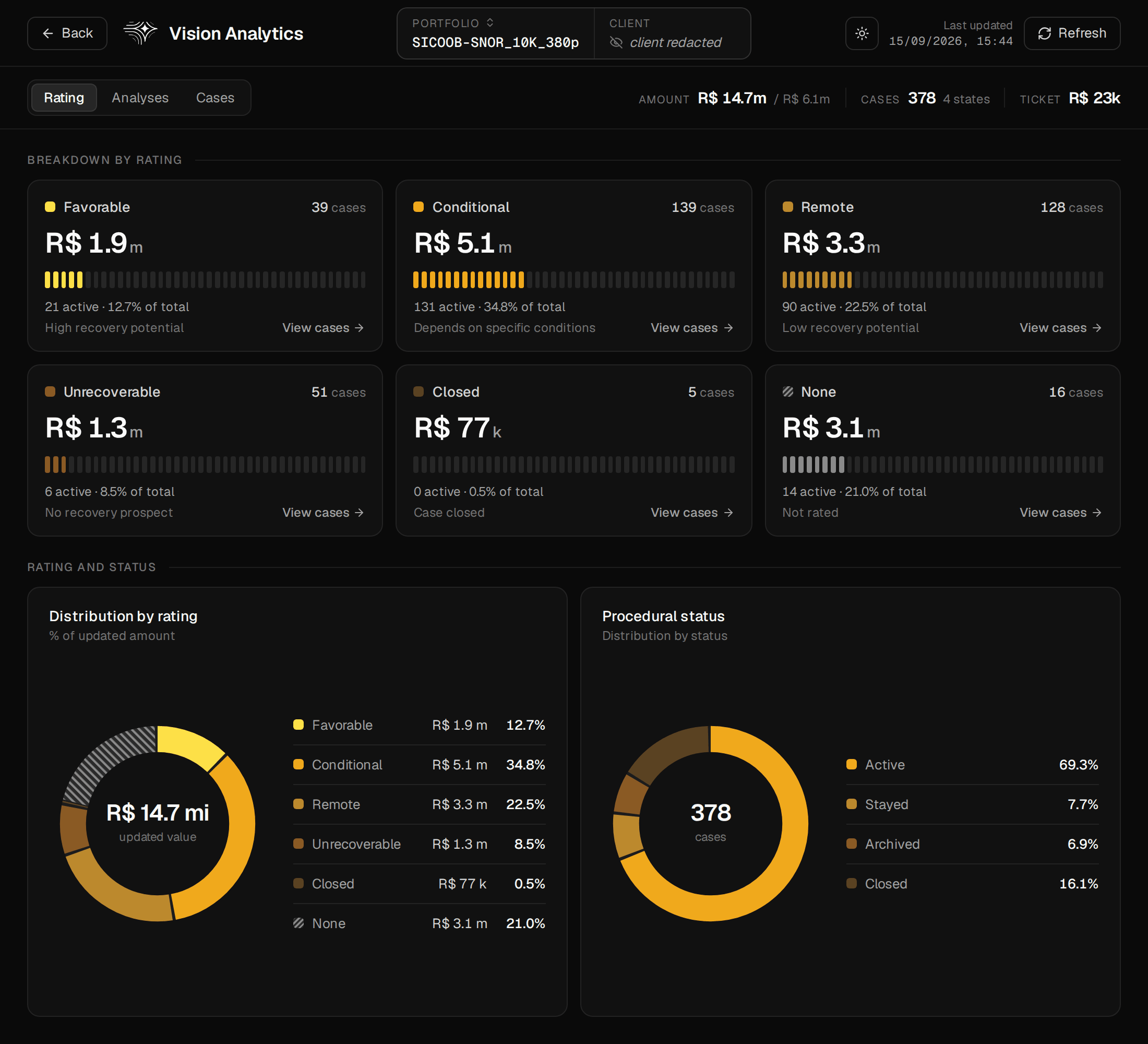
Tracking thousands of cases is not the same as understanding a portfolio. Current spreadsheets and deadlines under control are necessary, but on their own they do not show where the strongest recovery opportunities are. Axioma's intelligence radar combines deep reading of each case with continuous monitoring to show which cases to prioritize, where to act, and where the legal spend no longer pays for itself. From reacting to cases to managing recovery as a strategy.
90k+
pages reviewed in a single Brazilian court-supervised restructuring proceeding
+100
agents working on one case over roughly 1.5 hours
+15
case types covered, extended as demand grows
Soluções
Soluções
01
Inteligência de Carteiras
02
Decisão de Ajuizamento
03
Raio-X do Devedor
04
Análise de Matrículas
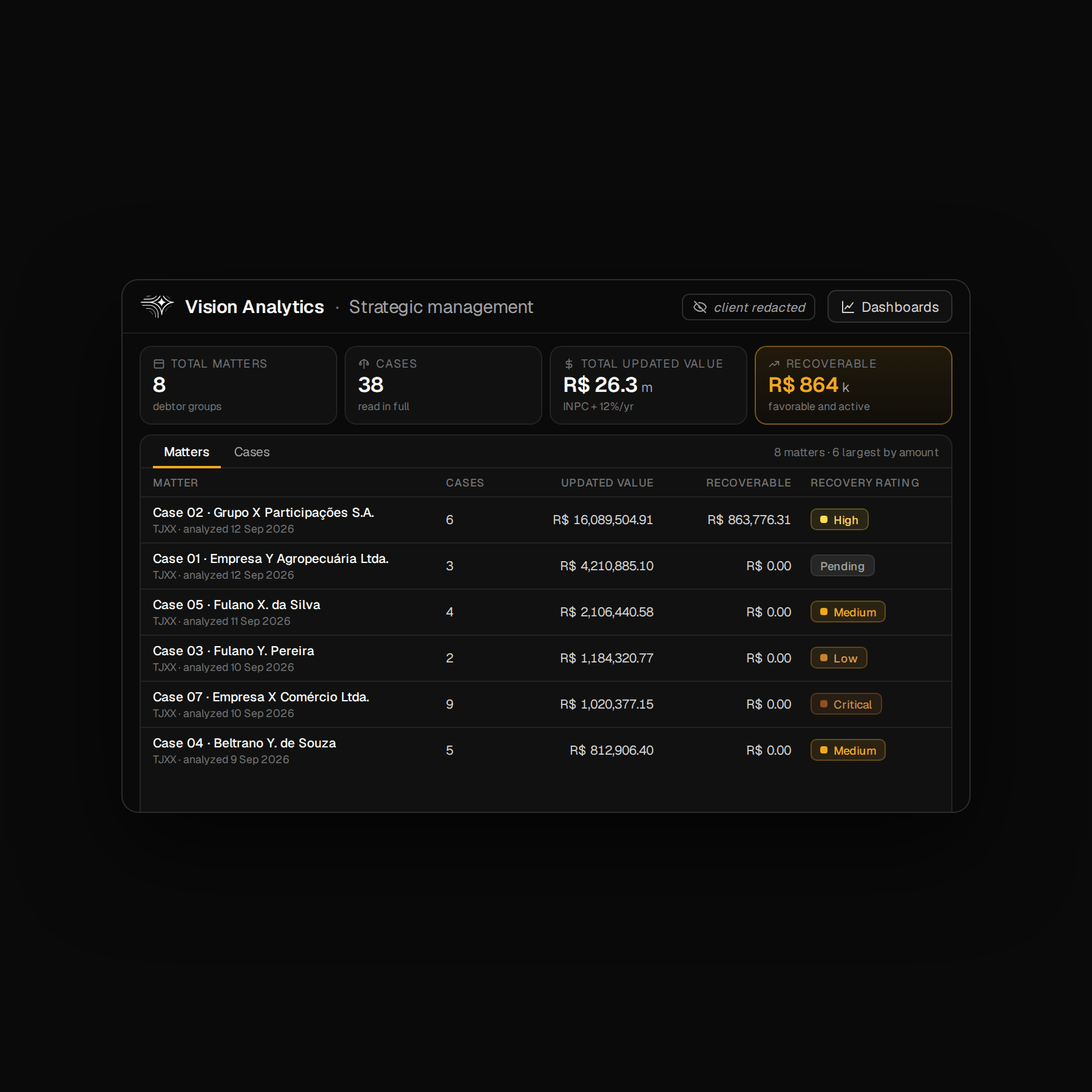
Every case read in full, with a report per case type, a recovery-potential rating and dashboards that answer “where should we act first”.
01
Inteligência de Carteiras
Cada processo lido na íntegra, com relatório por classe processual, classificação de recuperabilidade e dashboards que respondem “onde agir primeiro”.
02
Decisão de Ajuizamento
Antes de ajuizar: custas, tempo esperado, garantias, concorrência de credores e chance real de recuperação.

03
Raio-X do Devedor
O que os outros processos do tomador dizem sobre a liquidez dele antes de conceder, comprar ou renovar.

04
Análise de Matrículas
A história real do imóvel em linguagem de gestão: ônus, pendências e riscos ocultos, em menos de três minutos.

01
Inteligência de Carteiras
Cada processo lido na íntegra, com relatório por classe processual, classificação de recuperabilidade e dashboards que respondem “onde agir primeiro”.
02
Decisão de Ajuizamento
Antes de ajuizar: custas, tempo esperado, garantias, concorrência de credores e chance real de recuperação.
03
Raio-X do Devedor
O que os outros processos do tomador dizem sobre a liquidez dele antes de conceder, comprar ou renovar.
04
Análise de Matrículas
A história real do imóvel em linguagem de gestão: ônus, pendências e riscos ocultos, em menos de três minutos.
Results delivered
Sua gestão sabe responder às perguntas abaixo?
Which cases can actually be recovered?
The value genuinely within reach, and the cases closest to cash.
Which cases can actually be recovered?
The value genuinely within reach, and the cases closest to cash.
Where are we burning money?
Fees and court costs spent on cases unlikely to generate a return.
Where are we burning money?
Fees and court costs spent on cases unlikely to generate a return.
Where should the best people go?
Cases that need senior judgment, and cases that can run as routine.
Where should the best people go?
Cases that need senior judgment, and cases that can run as routine.
What should we do next?
Which cases deserve a settlement campaign, which have reachable assets, which need an asset search, and where the strategy has to change.
What should we do next?
Which cases deserve a settlement campaign, which have reachable assets, which need an asset search, and where the strategy has to change.

Analysis at scale
Recovery potential mapped
Strategic prioritization
Continuous monitoring
Traceable evidence
Purpose-built AI system
Human review
Analysis at scale
Recovery potential mapped
Strategic prioritization
Continuous monitoring
Traceable evidence
Purpose-built AI system
Human review
Analysis at scale
Recovery potential mapped
Strategic prioritization
Continuous monitoring
Traceable evidence
Purpose-built AI system
Human review
Who it's for
Para quem precisa decidir o que manter, assumir, o que comprar ou onde aprofundar.
The same intelligence serves different business decisions. Sometimes the goal is to pull effort out of portfolios with no economic upside. Sometimes it is to pick what is worth taking on, to support buying a loan book, or to go deep on specific cases with structured legal analysis.
- 01
- Banks and financial institutions
- Credit unions
- Funds and asset managers
- In-house legal teams
Find what is consuming time, capital and fees with no real prospect of recovery — so the portfolio stops being treated as one undifferentiated block.
What it means
This is not data hygiene. The logic here is economic: review the portfolio to find the cases that no longer justify further investment, either because recovery is remote or because the legal cost is likely to exceed the expected return.
When it applies
- When the portfolio has piled up cases with low recovery potential and no real order of priority.
- When the creditor wants to cut legal spend on cases that are not economically viable.
- When the manager needs to reallocate effort and concentrate resources where return is still possible.
What Axioma delivers
- Cases ranked by recovery potential.
- The cases with low economic priority or a remote chance of return.
- Findings and evidence behind each recommendation to review, keep or deprioritize.
- An analytical basis for cutting legal effort where the cost no longer pays.
Scope limit: the decision to drop, pause or redirect a case remains with the client and their own professionals.
Talk to us about this(opens in a new tab)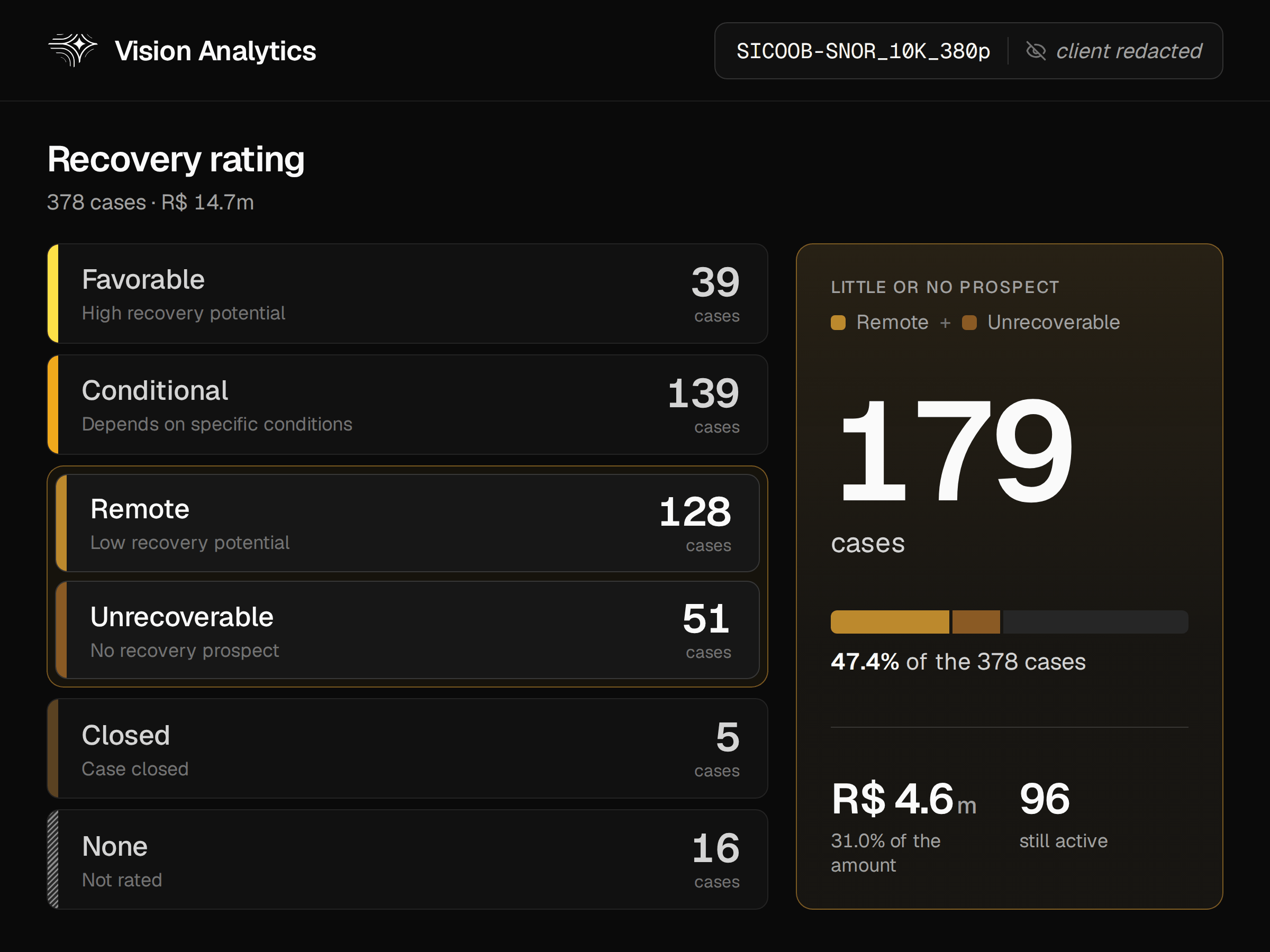
- 02
- Law firms
- Special situations funds and asset managers
Filter, across hundreds or thousands of cases, what is worth taking on — so a portfolio that looks large does not turn out to be a concentration of bad cases.
What it means
This mainly serves law firms taking on large portfolios on contingency. Because the fee depends on the outcome, accepting a book loaded with unrecoverable or remote cases can produce a loss, or gut the economics of the engagement.
When it applies
- When a firm has to decide whether to accept a new portfolio.
- When it is necessary to separate what should be taken on from what will absorb effort without proportionate return.
- When funds and managers want a first read of the portfolio before entering an opportunity whose value depends on case quality.
What Axioma delivers
- Analytical screening of the portfolio, focused on recovery potential.
- The more promising groups of cases, and the blocks with little upside.
- A technical basis for accepting, declining or shaping the proposal.
- Inputs for estimating legal effort and the economics of the engagement.
Scope limit: the final commercial decision to take on the portfolio, and the terms of the engagement, are not replaced by the report.
Talk to us about this(opens in a new tab)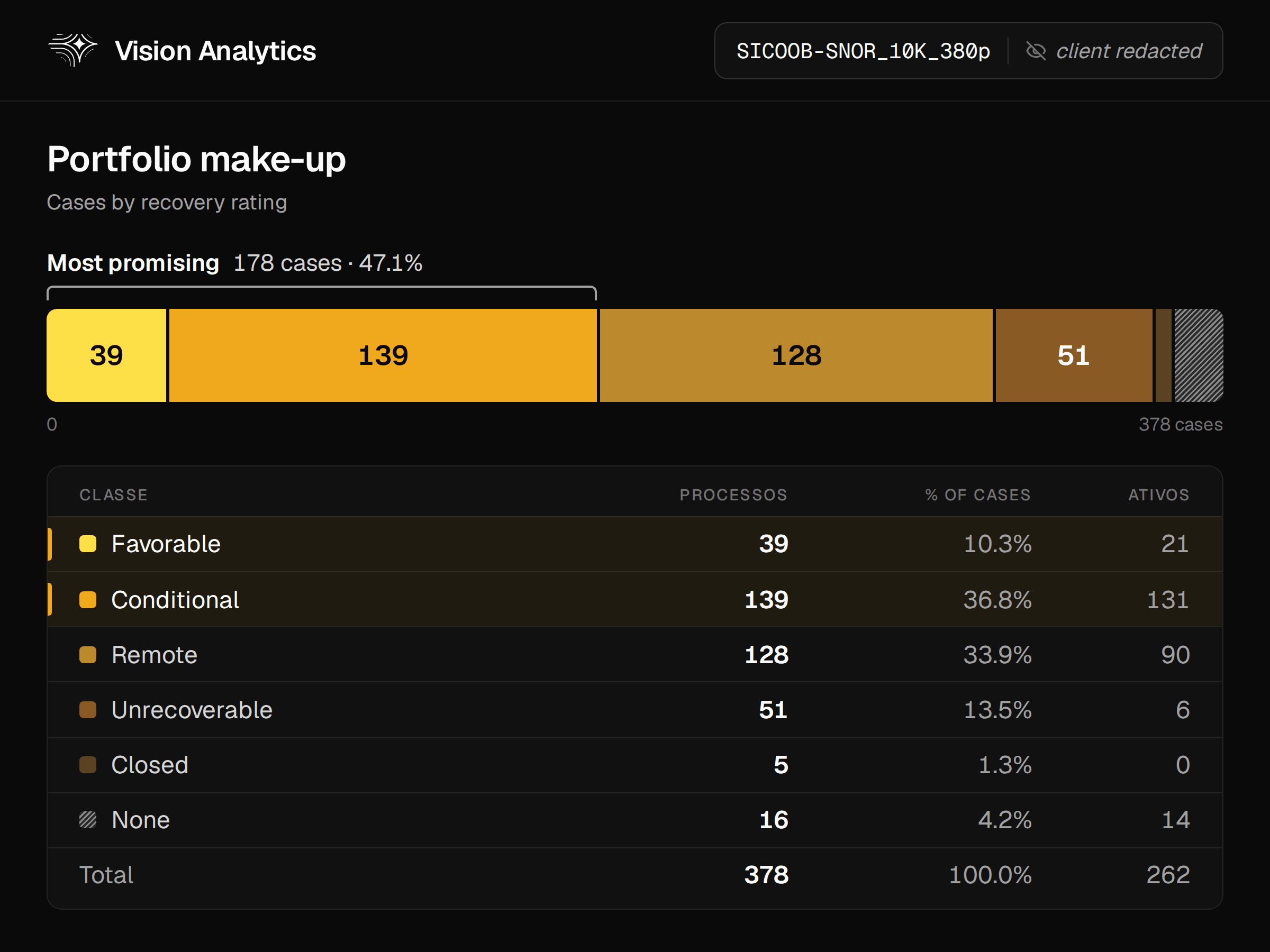
- 03
- Special situations funds and asset managers
- NPL investors
- Law firms
Support the decision to buy or walk away from a portfolio — including in competitive auctions — with a structured read of what is inside the cases, the collateral and the recovery potential.
What it means
This is the analysis of a set of cases to support an investment decision. It serves buyers assessing a direct purchase from a bank, taking part in an auction, or building a better-informed bid.
When it applies
- When an investor or buyer needs to understand portfolio quality before committing capital.
- When a surface read of the cases cannot support a bid or an acquisition proposal.
- When advising firms need to deepen the basis for their buy-side client's decision.
What Axioma delivers
- A structured analysis of the cases and their main economic and legal elements.
- A read on collateral, case stage and the signals that bear on recovery potential.
- Inputs for the buy decision, for comparing lots, and for shaping a bid.
- Support for pricing and for the economics of the acquisition, without promising a guaranteed final price.
Scope limit: the report supports the investment decision; it does not replace the investment policy, the buyer's internal approval, or an independent financial valuation where one is required.
Talk to us about this(opens in a new tab)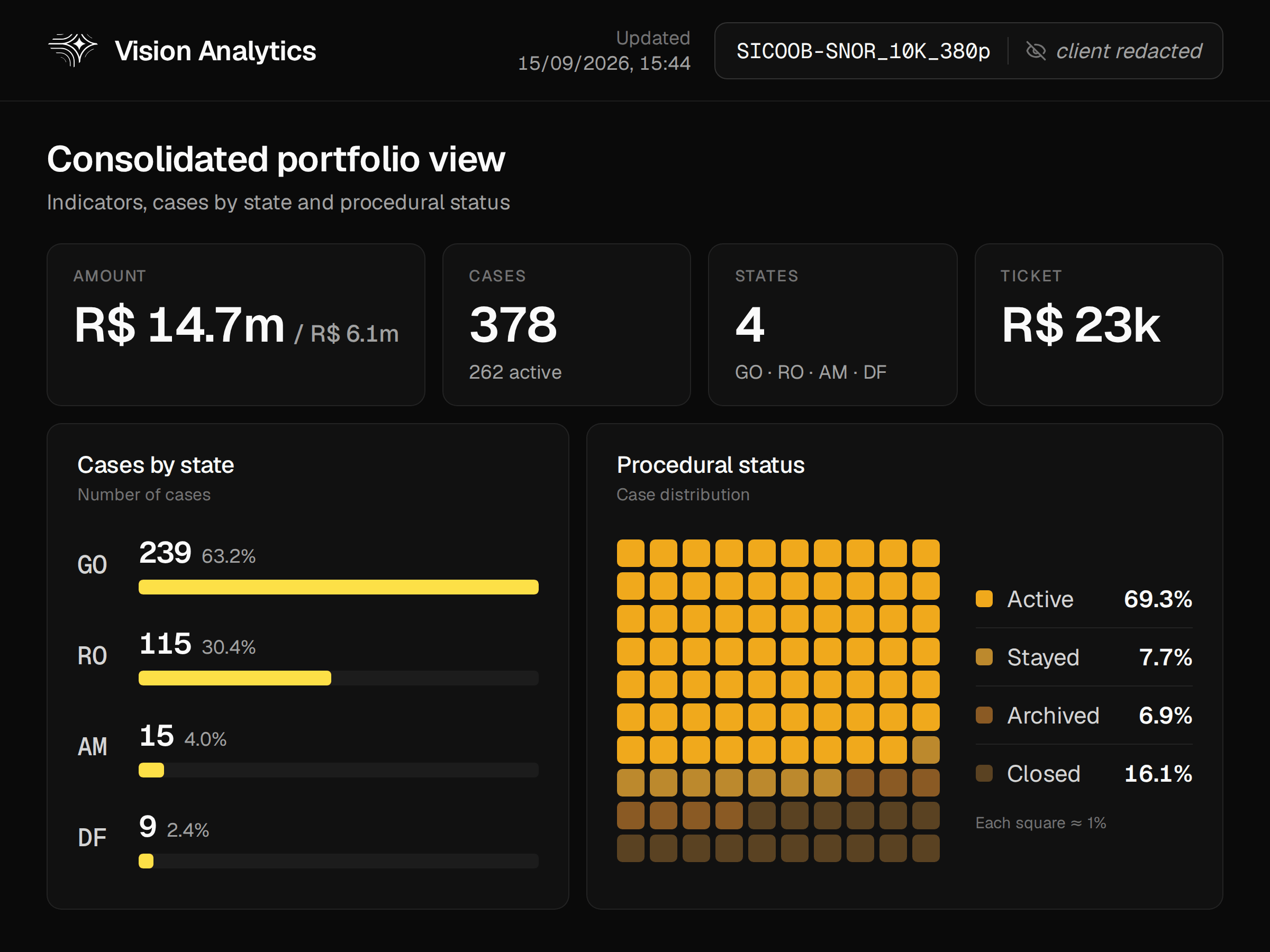
- 04
- Legal and due diligence advisors
- Funds and asset managers
- Law firms
Go deep on specific cases, smaller sets of cases, or M&A and asset-purchase situations, combining the system with special situations lawyers.
What it means
Not every need is about volume. Sometimes the client has to look closely at a handful of cases — three, five, a small related set — to ground one specific decision. There, Axioma can support a structured review and, where appropriate, work with qualified counsel engaged to deliver a legal opinion.
When it applies
- In M&A deals that require analysis of material litigation.
- In asset or loan purchases where a few cases carry most of the risk or the upside.
- When the client needs a deeper legal view of a few cases rather than a whole portfolio.
What Axioma delivers
- A structured read of the cases and of the findings that bear on the decision.
- The evidence and the red flags of a case, organized.
- Support for legal due diligence on cases or sets of cases.
- Where appropriate, a legal opinion delivered by qualified counsel, supported by Axioma's analysis.
Scope limit: the scope of any legal opinion, the responsible counsel, the professional obligations and the allocation of responsibility are defined in the engagement terms.
Talk to us about this(opens in a new tab)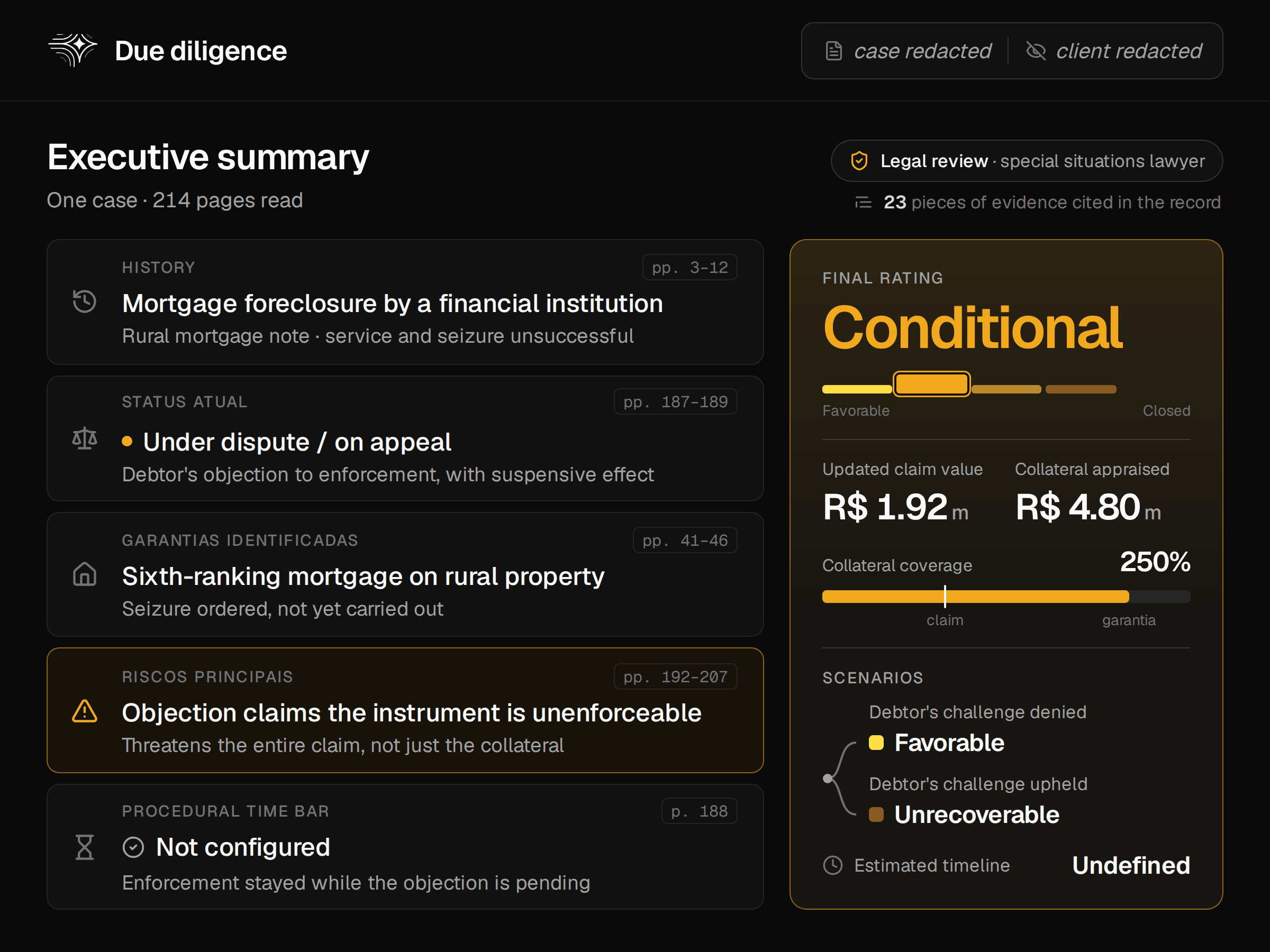
- 01
- Banks and financial institutions
- Credit unions
- Funds and asset managers
- In-house legal teams
Find what is consuming time, capital and fees with no real prospect of recovery — so the portfolio stops being treated as one undifferentiated block.
What it means
This is not data hygiene. The logic here is economic: review the portfolio to find the cases that no longer justify further investment, either because recovery is remote or because the legal cost is likely to exceed the expected return.
When it applies
- When the portfolio has piled up cases with low recovery potential and no real order of priority.
- When the creditor wants to cut legal spend on cases that are not economically viable.
- When the manager needs to reallocate effort and concentrate resources where return is still possible.
What Axioma delivers
- Cases ranked by recovery potential.
- The cases with low economic priority or a remote chance of return.
- Findings and evidence behind each recommendation to review, keep or deprioritize.
- An analytical basis for cutting legal effort where the cost no longer pays.
Scope limit: the decision to drop, pause or redirect a case remains with the client and their own professionals.
Talk to us about this(opens in a new tab) - 02
- Law firms
- Special situations funds and asset managers
Filter, across hundreds or thousands of cases, what is worth taking on — so a portfolio that looks large does not turn out to be a concentration of bad cases.
What it means
This mainly serves law firms taking on large portfolios on contingency. Because the fee depends on the outcome, accepting a book loaded with unrecoverable or remote cases can produce a loss, or gut the economics of the engagement.
When it applies
- When a firm has to decide whether to accept a new portfolio.
- When it is necessary to separate what should be taken on from what will absorb effort without proportionate return.
- When funds and managers want a first read of the portfolio before entering an opportunity whose value depends on case quality.
What Axioma delivers
- Analytical screening of the portfolio, focused on recovery potential.
- The more promising groups of cases, and the blocks with little upside.
- A technical basis for accepting, declining or shaping the proposal.
- Inputs for estimating legal effort and the economics of the engagement.
Scope limit: the final commercial decision to take on the portfolio, and the terms of the engagement, are not replaced by the report.
Talk to us about this(opens in a new tab) - 03
- Special situations funds and asset managers
- NPL investors
- Law firms
Support the decision to buy or walk away from a portfolio — including in competitive auctions — with a structured read of what is inside the cases, the collateral and the recovery potential.
What it means
This is the analysis of a set of cases to support an investment decision. It serves buyers assessing a direct purchase from a bank, taking part in an auction, or building a better-informed bid.
When it applies
- When an investor or buyer needs to understand portfolio quality before committing capital.
- When a surface read of the cases cannot support a bid or an acquisition proposal.
- When advising firms need to deepen the basis for their buy-side client's decision.
What Axioma delivers
- A structured analysis of the cases and their main economic and legal elements.
- A read on collateral, case stage and the signals that bear on recovery potential.
- Inputs for the buy decision, for comparing lots, and for shaping a bid.
- Support for pricing and for the economics of the acquisition, without promising a guaranteed final price.
Scope limit: the report supports the investment decision; it does not replace the investment policy, the buyer's internal approval, or an independent financial valuation where one is required.
Talk to us about this(opens in a new tab) - 04
- Legal and due diligence advisors
- Funds and asset managers
- Law firms
Go deep on specific cases, smaller sets of cases, or M&A and asset-purchase situations, combining the system with special situations lawyers.
What it means
Not every need is about volume. Sometimes the client has to look closely at a handful of cases — three, five, a small related set — to ground one specific decision. There, Axioma can support a structured review and, where appropriate, work with qualified counsel engaged to deliver a legal opinion.
When it applies
- In M&A deals that require analysis of material litigation.
- In asset or loan purchases where a few cases carry most of the risk or the upside.
- When the client needs a deeper legal view of a few cases rather than a whole portfolio.
What Axioma delivers
- A structured read of the cases and of the findings that bear on the decision.
- The evidence and the red flags of a case, organized.
- Support for legal due diligence on cases or sets of cases.
- Where appropriate, a legal opinion delivered by qualified counsel, supported by Axioma's analysis.
Scope limit: the scope of any legal opinion, the responsible counsel, the professional obligations and the allocation of responsibility are defined in the engagement terms.
Talk to us about this(opens in a new tab)
- 01
- Banks and financial institutions
- Credit unions
- Funds and asset managers
- In-house legal teams
Find what is consuming time, capital and fees with no real prospect of recovery — so the portfolio stops being treated as one undifferentiated block.
What it means
This is not data hygiene. The logic here is economic: review the portfolio to find the cases that no longer justify further investment, either because recovery is remote or because the legal cost is likely to exceed the expected return.
When it applies
- When the portfolio has piled up cases with low recovery potential and no real order of priority.
- When the creditor wants to cut legal spend on cases that are not economically viable.
- When the manager needs to reallocate effort and concentrate resources where return is still possible.
What Axioma delivers
- Cases ranked by recovery potential.
- The cases with low economic priority or a remote chance of return.
- Findings and evidence behind each recommendation to review, keep or deprioritize.
- An analytical basis for cutting legal effort where the cost no longer pays.
Scope limit: the decision to drop, pause or redirect a case remains with the client and their own professionals.
Talk to us about this(opens in a new tab) - 02
- Law firms
- Special situations funds and asset managers
Filter, across hundreds or thousands of cases, what is worth taking on — so a portfolio that looks large does not turn out to be a concentration of bad cases.
What it means
This mainly serves law firms taking on large portfolios on contingency. Because the fee depends on the outcome, accepting a book loaded with unrecoverable or remote cases can produce a loss, or gut the economics of the engagement.
When it applies
- When a firm has to decide whether to accept a new portfolio.
- When it is necessary to separate what should be taken on from what will absorb effort without proportionate return.
- When funds and managers want a first read of the portfolio before entering an opportunity whose value depends on case quality.
What Axioma delivers
- Analytical screening of the portfolio, focused on recovery potential.
- The more promising groups of cases, and the blocks with little upside.
- A technical basis for accepting, declining or shaping the proposal.
- Inputs for estimating legal effort and the economics of the engagement.
Scope limit: the final commercial decision to take on the portfolio, and the terms of the engagement, are not replaced by the report.
Talk to us about this(opens in a new tab) - 03
- Special situations funds and asset managers
- NPL investors
- Law firms
Support the decision to buy or walk away from a portfolio — including in competitive auctions — with a structured read of what is inside the cases, the collateral and the recovery potential.
What it means
This is the analysis of a set of cases to support an investment decision. It serves buyers assessing a direct purchase from a bank, taking part in an auction, or building a better-informed bid.
When it applies
- When an investor or buyer needs to understand portfolio quality before committing capital.
- When a surface read of the cases cannot support a bid or an acquisition proposal.
- When advising firms need to deepen the basis for their buy-side client's decision.
What Axioma delivers
- A structured analysis of the cases and their main economic and legal elements.
- A read on collateral, case stage and the signals that bear on recovery potential.
- Inputs for the buy decision, for comparing lots, and for shaping a bid.
- Support for pricing and for the economics of the acquisition, without promising a guaranteed final price.
Scope limit: the report supports the investment decision; it does not replace the investment policy, the buyer's internal approval, or an independent financial valuation where one is required.
Talk to us about this(opens in a new tab) - 04
- Legal and due diligence advisors
- Funds and asset managers
- Law firms
Go deep on specific cases, smaller sets of cases, or M&A and asset-purchase situations, combining the system with special situations lawyers.
What it means
Not every need is about volume. Sometimes the client has to look closely at a handful of cases — three, five, a small related set — to ground one specific decision. There, Axioma can support a structured review and, where appropriate, work with qualified counsel engaged to deliver a legal opinion.
When it applies
- In M&A deals that require analysis of material litigation.
- In asset or loan purchases where a few cases carry most of the risk or the upside.
- When the client needs a deeper legal view of a few cases rather than a whole portfolio.
What Axioma delivers
- A structured read of the cases and of the findings that bear on the decision.
- The evidence and the red flags of a case, organized.
- Support for legal due diligence on cases or sets of cases.
- Where appropriate, a legal opinion delivered by qualified counsel, supported by Axioma's analysis.
Scope limit: the scope of any legal opinion, the responsible counsel, the professional obligations and the allocation of responsibility are defined in the engagement terms.
Talk to us about this(opens in a new tab)
How it works
Basta fornecer os
números dos processos
da carteira.
Performance designed for your supply chain.
01
AXION
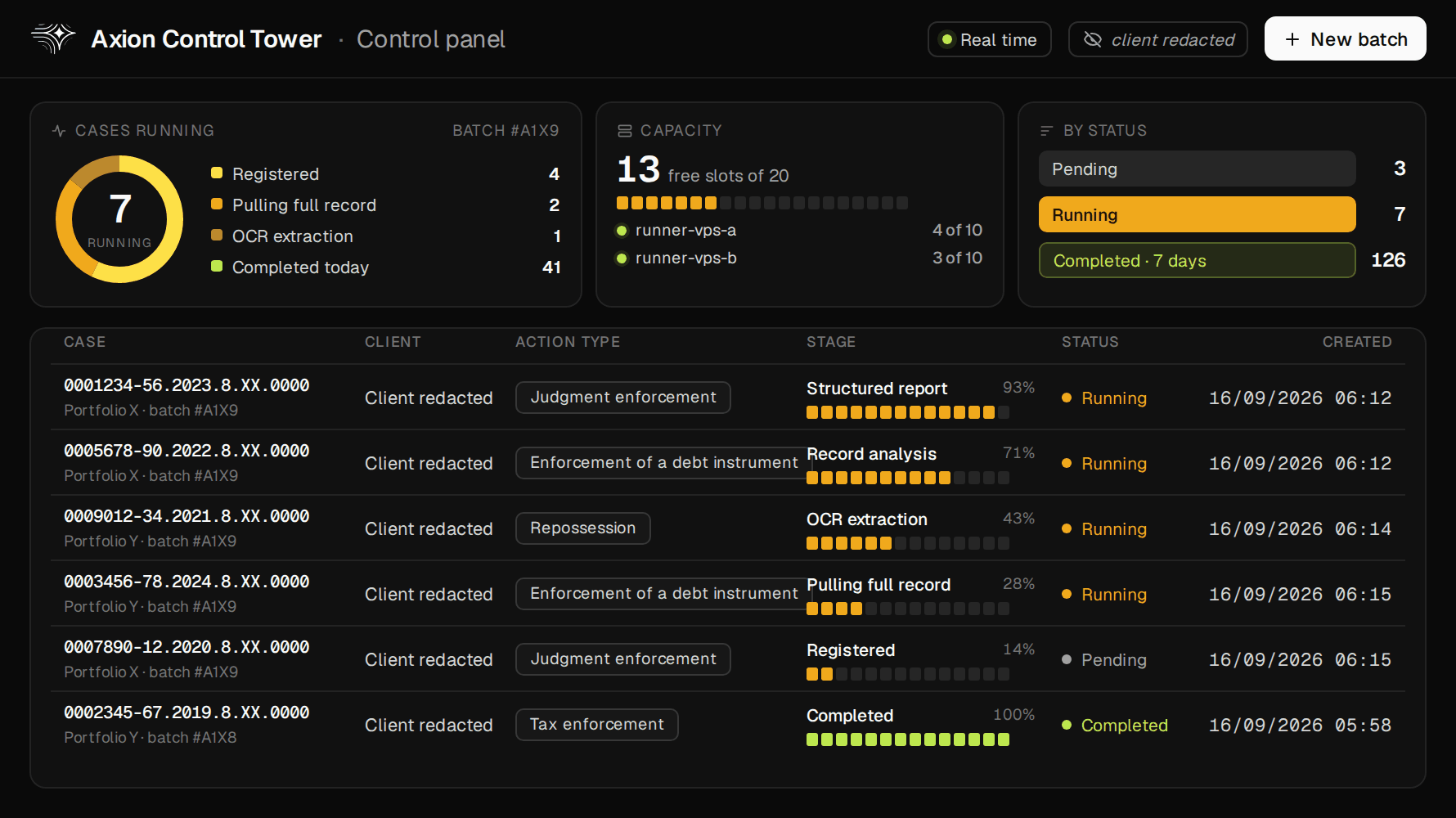
You hand over the list of cases. The system pulls the official full case record from the courts and indexes everything, including cases connected to the main one, then produces a complete structured report with a concise executive summary for a fast, comprehensive view of the matter.
01
AXION
You hand over the list of cases. The system pulls the official full case record from the courts and indexes everything, including cases connected to the main one, then produces a complete structured report with a concise executive summary for a fast, comprehensive view of the matter.
01
AXION
You hand over the list of cases. The system pulls the official full case record from the courts and indexes everything, including cases connected to the main one, then produces a complete structured report with a concise executive summary for a fast, comprehensive view of the matter.
02
VIEWER
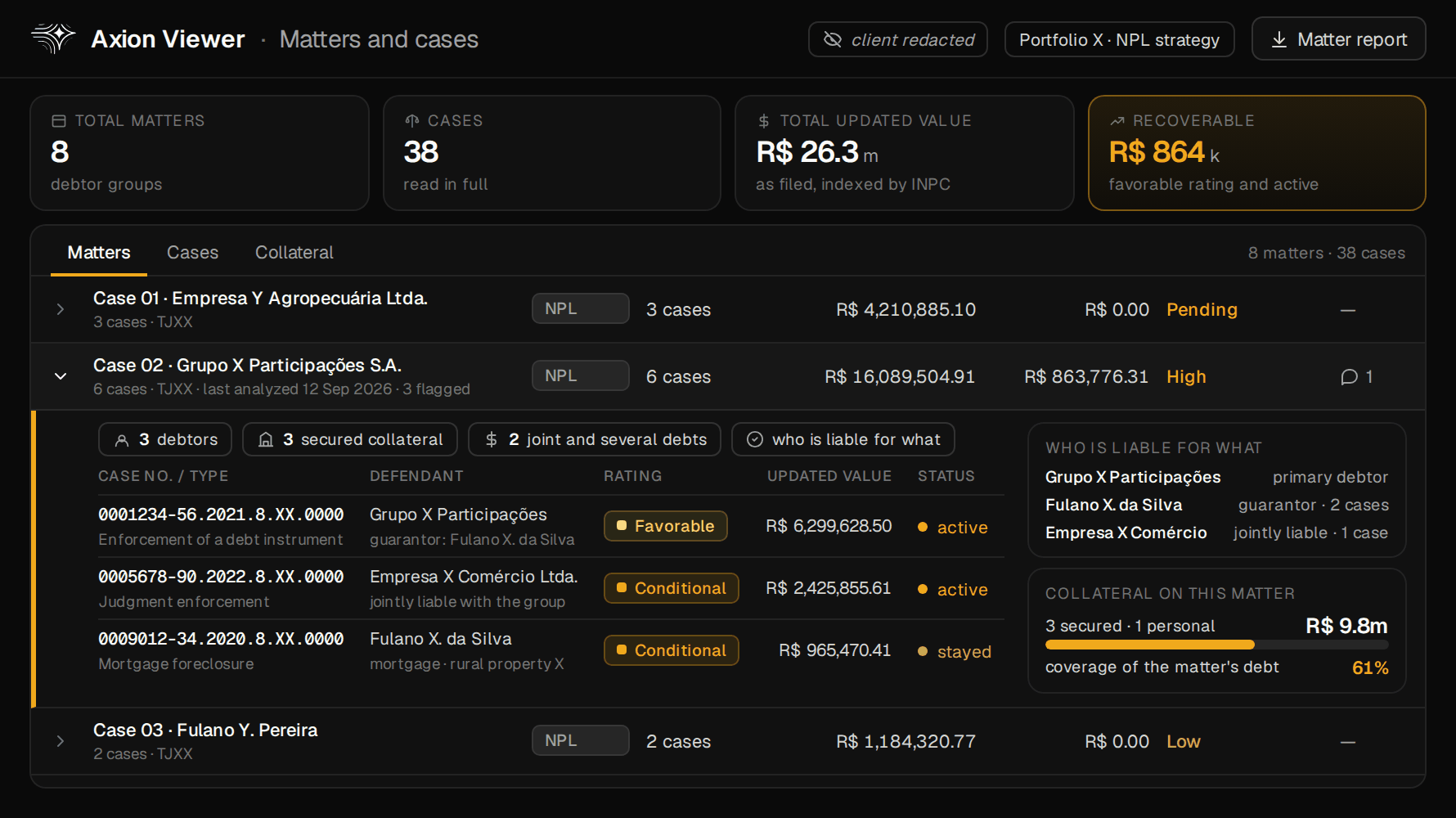
Court cases against the same debtor or corporate group are consolidated into one debtor matter: a report per case plus a group-level report, with all collateral and guarantees, all debts, all debtors, and who is liable for what.
02
VIEWER
Court cases against the same debtor or corporate group are consolidated into one debtor matter: a report per case plus a group-level report, with all collateral and guarantees, all debts, all debtors, and who is liable for what.
02
VIEWER
Court cases against the same debtor or corporate group are consolidated into one debtor matter: a report per case plus a group-level report, with all collateral and guarantees, all debts, all debtors, and who is liable for what.
03
VISION
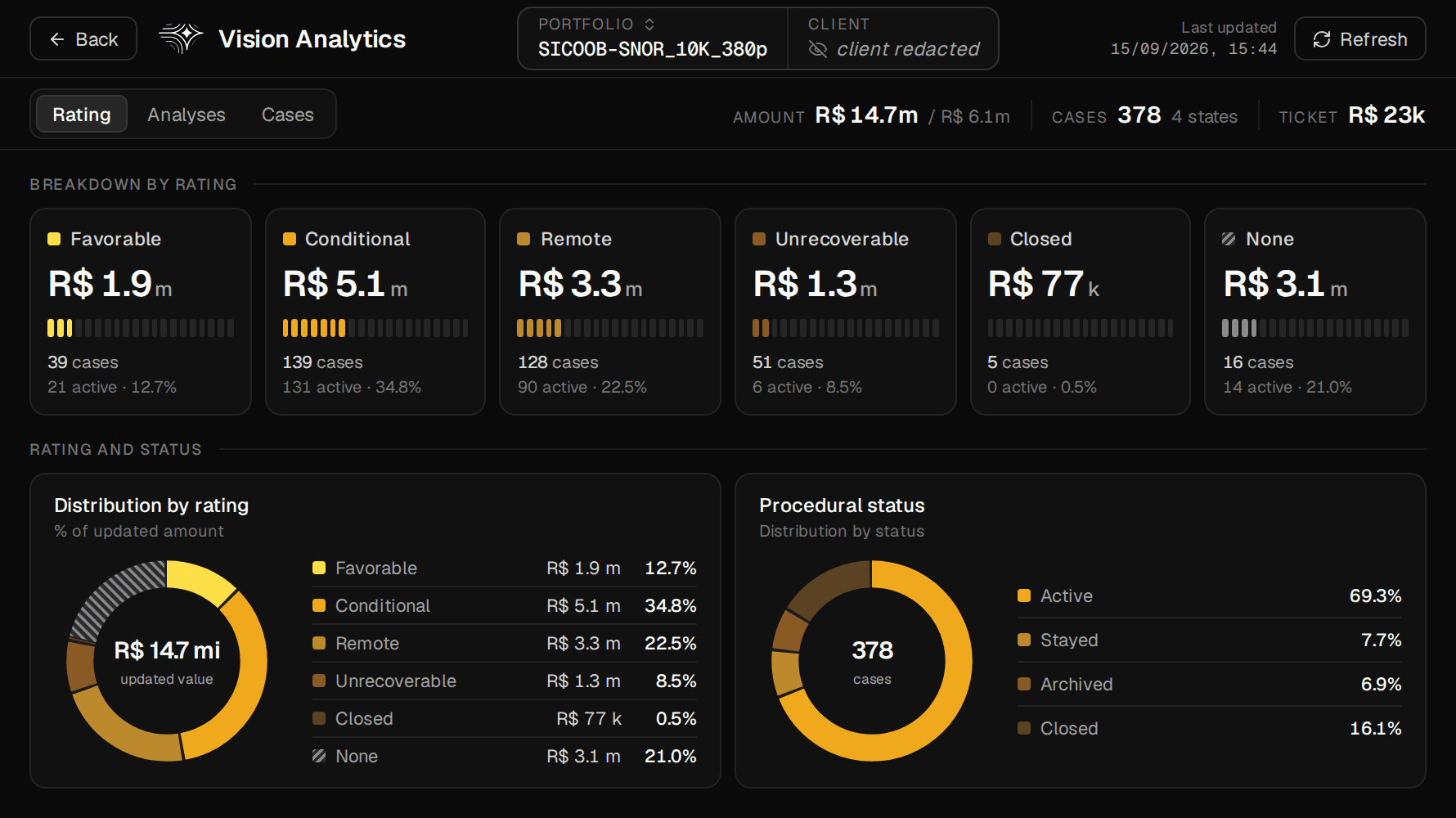
Dashboards that answer “where should we act first”: amount at stake, recovery-potential rating, type of action, procedural stage, difficulty, state, venue and court.
03
VISION
Dashboards that answer “where should we act first”: amount at stake, recovery-potential rating, type of action, procedural stage, difficulty, state, venue and court.
03
VISION
Dashboards that answer “where should we act first”: amount at stake, recovery-potential rating, type of action, procedural stage, difficulty, state, venue and court.
04
CORTEX
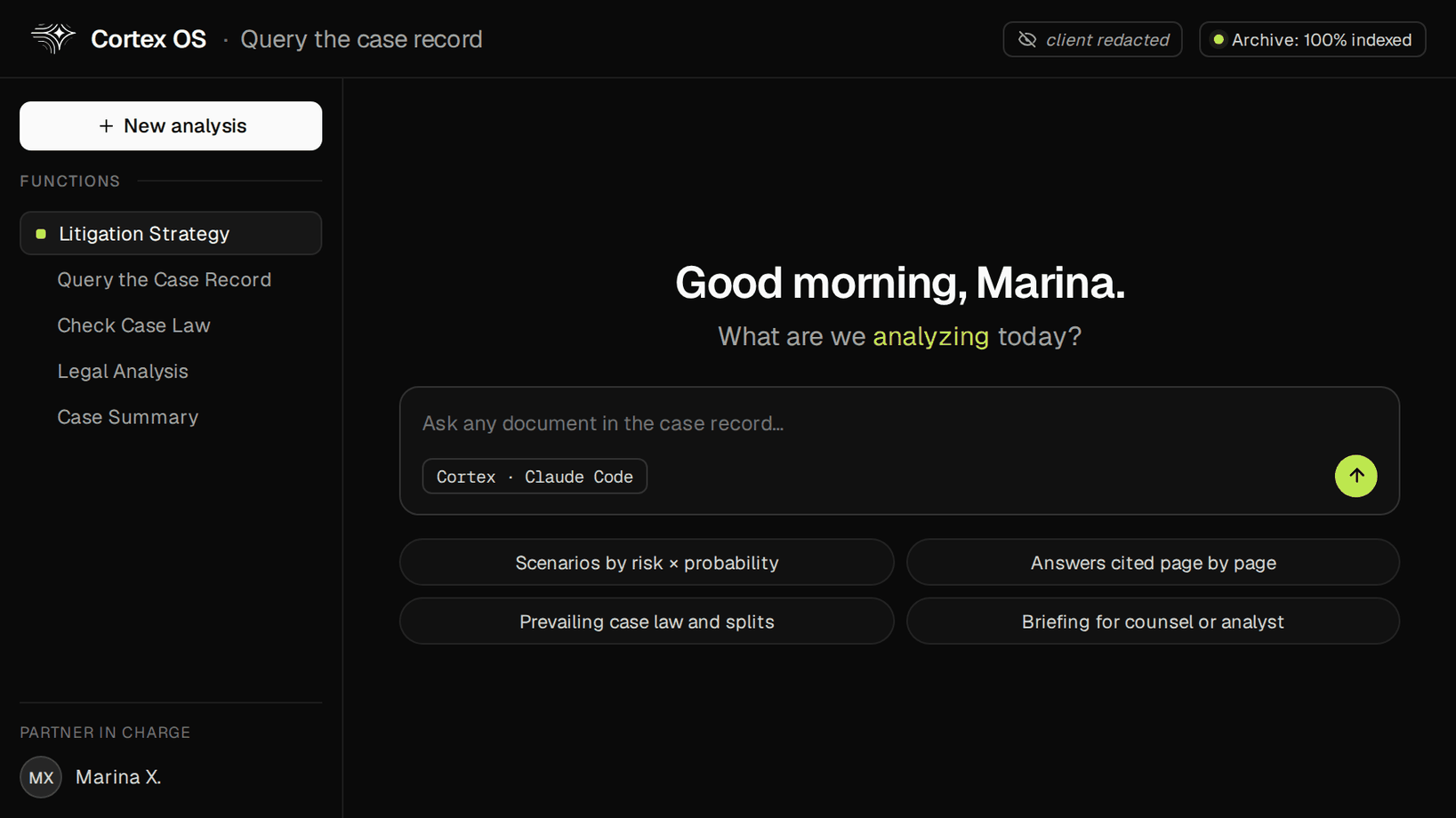
Lawyers and portfolio managers query the indexed full record directly: answers that cite the exact page of the file, follow-up analysis, and drafts with the reasoning attached.
04
CORTEX
Lawyers and portfolio managers query the indexed full record directly: answers that cite the exact page of the file, follow-up analysis, and drafts with the reasoning attached.
04
CORTEX
Lawyers and portfolio managers query the indexed full record directly: answers that cite the exact page of the file, follow-up analysis, and drafts with the reasoning attached.
05
MONITORING
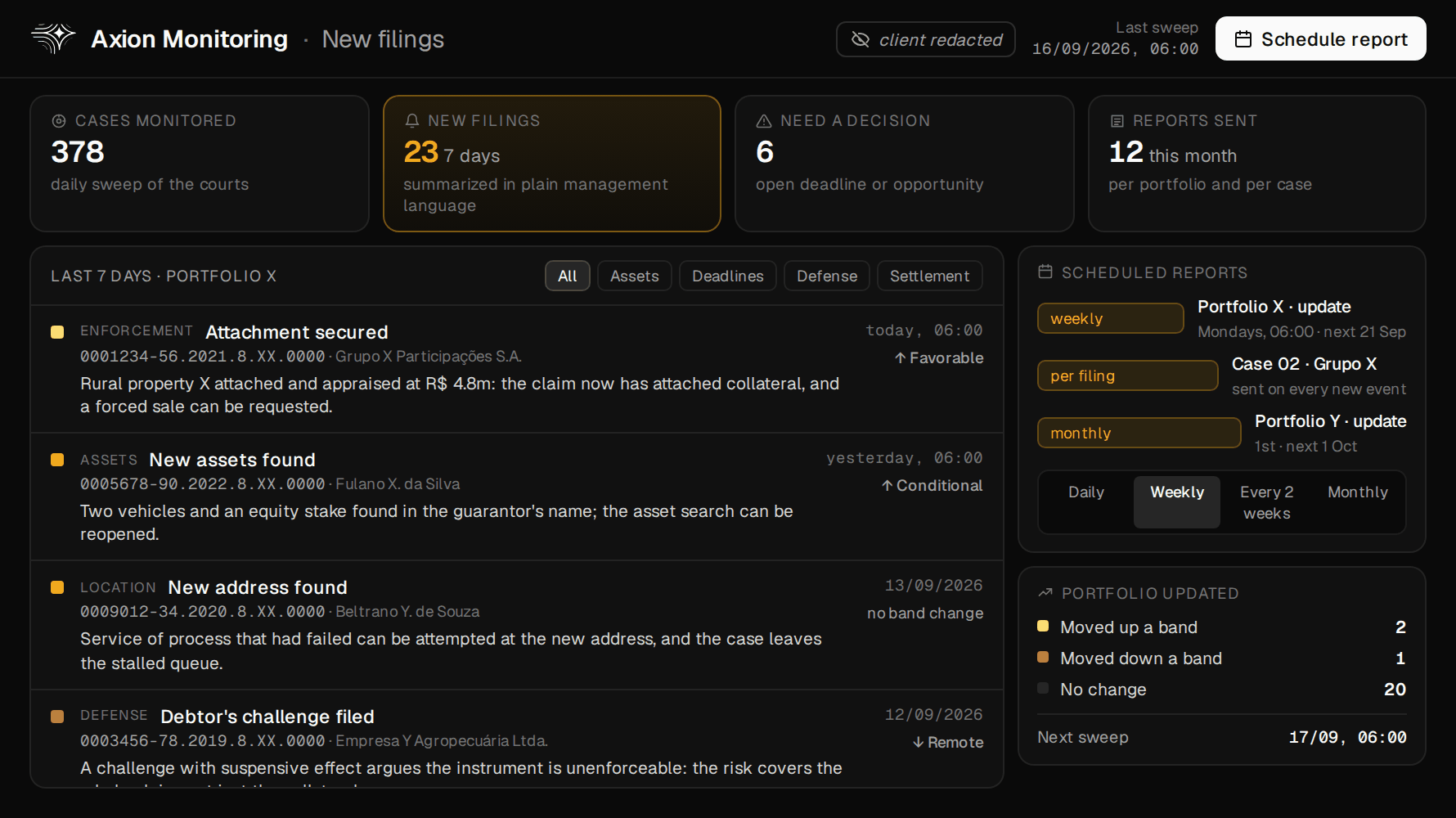
Detects new docket activity, summarizes it in plain management language, and updates the portfolio. Update reports can be scheduled per case and per frequency.
05
MONITORING
Detects new docket activity, summarizes it in plain management language, and updates the portfolio. Update reports can be scheduled per case and per frequency.
05
MONITORING
Detects new docket activity, summarizes it in plain management language, and updates the portfolio. Update reports can be scheduled per case and per frequency.
Who already runs on Axioma